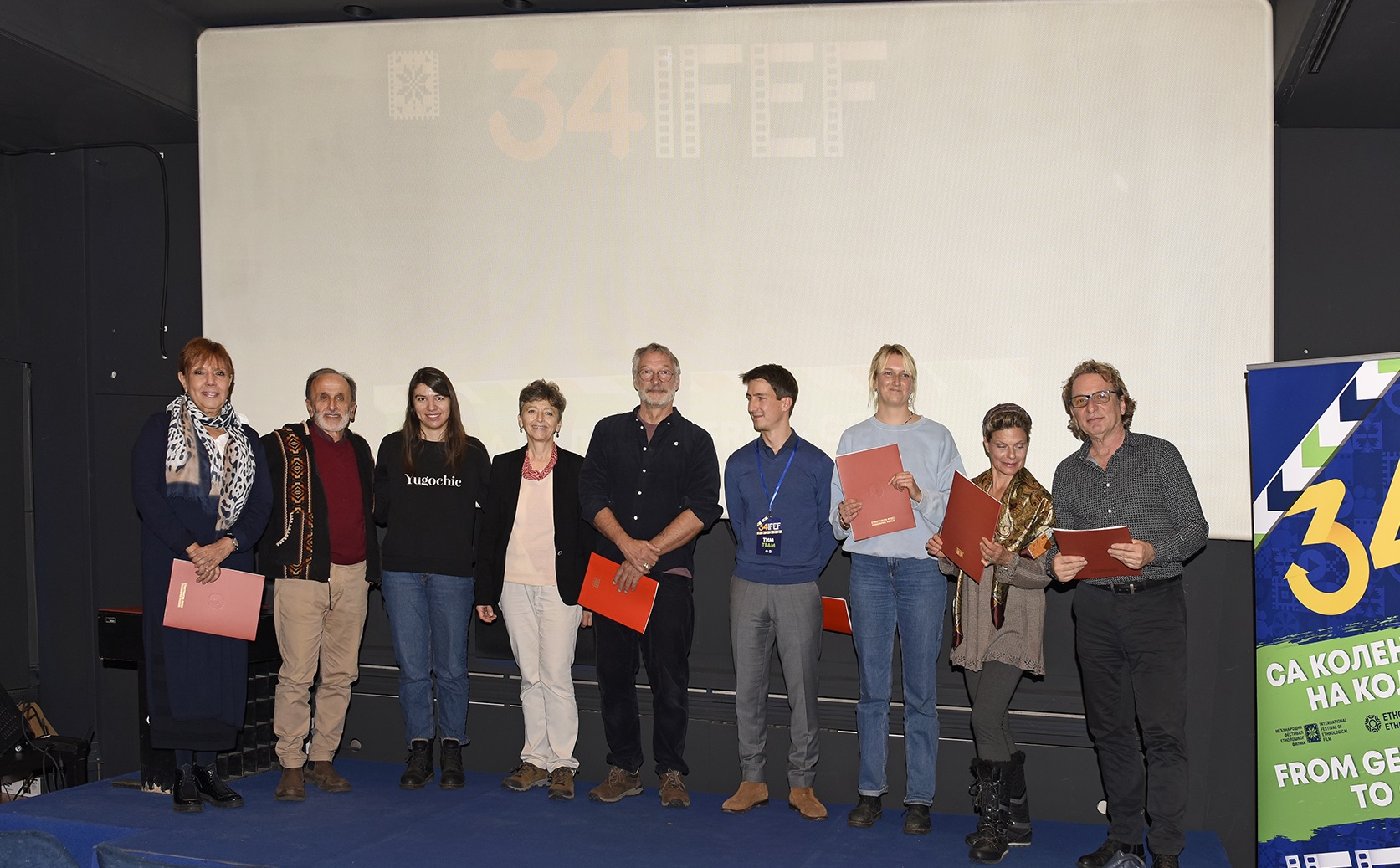
On the evening of 7 December 2025, the closing ceremony of the 34th International festival of ethnological film took place at the Ethnographic Museum in Belgrade. The event was an opportunity to announce this year’s award winners, and the Festival jury – comprised of Matthijs van de Port, anthropologist, Elizabeta Koneska, ethnologist, and Emilija Gašić, director and cinematographer– took to the stage of the cinema hall to reveal their decisions.
The jury’s statements are presented in full:
The winner of the 34th IFEF Grand Prix “Dragoslav Antonijević” is the film The Last Shore by Jean-François Ravagnan, Belgium/France/Qatar
With clarity and respect, this film reconstructs the life obscured behind a viral video, transforming a moment of bystander inaction into a meditation on borders, racism, and the ethics of coexistence. Its talk-head-free, observational approach offers a profound anthropological insight into how humanity – and inhumanity – surface in the smallest, most devastating gestures.
Best National Film Award: Danglers, Andrijana Jelić, Marija Ritan, Miodrag Savić, Serbia
The viewer of Danglers is taken to a roadside tavern somewhere deep in Serbia, the meeting point of a number of old men. They do what old men tend to do in a roadside tavern: they drink, roast a pig, dig up memories and contemplate a live that was lived. And if the filmmakers want them to play the frula, sure, why not? Danglers pays tribute to a generation who, after a life of struggle and hard work, find themselves on their way out -- sadder and wiser. It is exactly by touching on deeply existential themes in a mundane, everyday setting that Danglers exemplifies ethnographic film at its best.
Best Foreign Film: A Move, Elahe Esmaili, Iran
Elahe Esmaili’s A Move is an intimate portrait of an Iranian family moving house, a moment when everything that was fixed and given comes loose, including ideas, norms and attitudes. Registering the tensions and discussions that follow the refusal of one family member to wear the veil, the film is a brilliant exploration of conformation and resistance in an authoritarian society. We could not pass a jury report without mentioning the visual symphony that is Perović’s film Goodlands. But in the end, we decided for the intricate subtleties of a sonata: the winner of the International competition is Elahe Esmaili’s “A Move”.
Best Student Film Award:
Below the Surface, Sarah Noordeloos, Netherlands
Warp and Weft, Isolda Milenković, United Kingdom
Below the surface, by Sarah Noordeloos, takes us to Ghana, and draws us into the colors, textures and sounds of the local fishing industry. There is hardship and precarity, but nothing can undo the beauty of the images. Whose gaze is this, one keeps wondering. Whose aesthetics? The answer is clear: all throughout the film we hear people addressing the filmmaker as “obroni” (the local term for white person), and only gradually she gets to be addressed by her name. Stressing her positionality as an outsider, who nonetheless is able to relate to the people she encounters, makes the film a beautiful example of what longtime, immersive fieldwork can bring.
Warp & Weft, by Isolda Milenkovic, is a three minute blast! The film radically challenges the received wisdom that ethnographic films need to be long and slow. The animation is exceptionally well executed, and makes us marvel anew at traditional textile crafts – and in extension at the women’s hands that have been producing this beauty from generation to generation. The work is a powerful reminder that animated film can force us to become aware of the beauty that is all around us in the everyday.
“Dobrivoje Pantelić” Award for Best film about indigenous culture in own production: Safoora, Parviz Rostemi, Iran
A rich and detailed document of the custom dedicated to Safoora. It is a custom performed by women only, who offer a bloodless sacrifice to a demon with the goal of curing the week and sick, and providing rain and a bountiful year. A special strength of the film is a realistic depiction of a ritual trance accompanied by traditional music performed by the participants themselves. The film is work of an author who is expressive in his use of elements of film language.
Best Television Film: The ‘bake’ of Murter, Ivo Kuzmanić, Croatia
What makes a good ethnographic film for television audiences? The jury found that The ‘bake’ of Murter might well be a compelling example. Focusing on a local carnival at Murter island, where for three days people roam the streets with masks and home made carnival costumes, the film goes beyond the mere documenting of custom. Showing how the preparation for the carnival strengthens a sense of community, and how the carnival itself brings life to the ‘silent winter’ in a place with a tourist economy, the ‘ethnographic’ is no longer something that belongs to a museum, but part and parcel of communal life.
Special mention – contribution to intangible cultural heritage: Reed-mat Weavers, Milica Bajić Đogo, Serbia
A meticulous approach in the presentation of reed mat making, from growing “plants” – reeds, to the final product, its market placement and use. The inclusion of three generations of all community members in nurturing the skill, from the growing of plants to creating the product, gives the film complete legitimacy as guardian of intangible cultural heritage.The film about reed-mat wearers is visually well thought-out, with elements of traditional culture reconstructed in great detail.
Special mention – best ethnographic record: Crossing, Karol Felicio, Brazil
Karol Felicio’s Crossing is a beautiful film shot in the state of Espirito Santo, in Brazil. It follows a classical ethnographic approach: elaborating what becomes of traditional indigenous ideas and practices surrounding birth in the context of modernity. Strong photography, likable characters and the universal human tensions around birth and birth giving ensure the viewers ongoing attention. And when the hospital nurse keeps insisting that the Indian couple will be treated respectfully, one becomes uncomfortably aware that apparently such things are not self-evident. All in all, Crossing is an important and revealing record of indigenous life in Brazil in the 2020s.
Special mention – cinematography: You River, Izabela Zubrycka, Poland
Shot in striking black and white, its cinematography adopts the perspective of the river itself, gliding through gatherings, animals, and quiet rituals with a calm, unbroken gaze that feels both ancient and alive. The camera becomes a living current, dissolving the boundary between viewer and landscape, allowing us to experience the world not as observers but as the river's own steady, remembering flow.
Special mention – sound: Goodlands, Vladimir Perović, Montenegro
Through an evocative and immersive soundscape, the film brings the remote mountain villages to life, letting the textures of silence, nature, and aging voices tell their own story. The sound becomes a profound conduit to the solitude and beauty of these hidden communities.